The first step is arriving in Anchorage. Plan to land on the Saturday before your package week starts.
From Anchorage, Valdez is either a short flight or a scenic five-hour drive. This is not a K2 expedition, but there are real things to consider about getting to and from Valdez, and about what gear to bring. Contact us with your travel plans, including your arrival time in Valdez, so we can arrange your transport.
Getting there
Anchorage first, then 40 minutes or 300 miles.
Into Anchorage
ANC is one or two flights from almost anywhere in the world — direct or connecting from Seattle, Portland, Las Vegas, Los Angeles, Denver, Chicago, Phoenix and Minneapolis, among others.
If you need a night in Anchorage there are good options; The Lakefront Anchorage offers an ASG guest rate and runs a shuttle.
Flying to Valdez
A 40-minute flight, but read this first. One airline serves Valdez. Book through the airline or a major carrier — not through Expedia, Priceline or other third parties, because changing a flight afterwards becomes very difficult.
The last flight into Valdez boards mid-afternoon, so check your itinerary or you will be overnighting in Anchorage. You may need to collect and re-check bags, so leave at least an hour and fifteen minutes.
Driving to Valdez
About 300 miles and five to six hours, on two-lane highway to Palmer and then a winding, scenic run to the coast. Roads are well maintained but watch for frost heaves.
Cell coverage has improved but still has gaps — load your directions before you pass Palmer. Fuel is cheapest in Palmer and Glennallen.
Where you sleep
In town, or up on the pass.
Totem Inn, Valdez
Inclusive package guests stay at the Totem Inn. Single occupancy as standard, double available on request.
Motor home parking at base
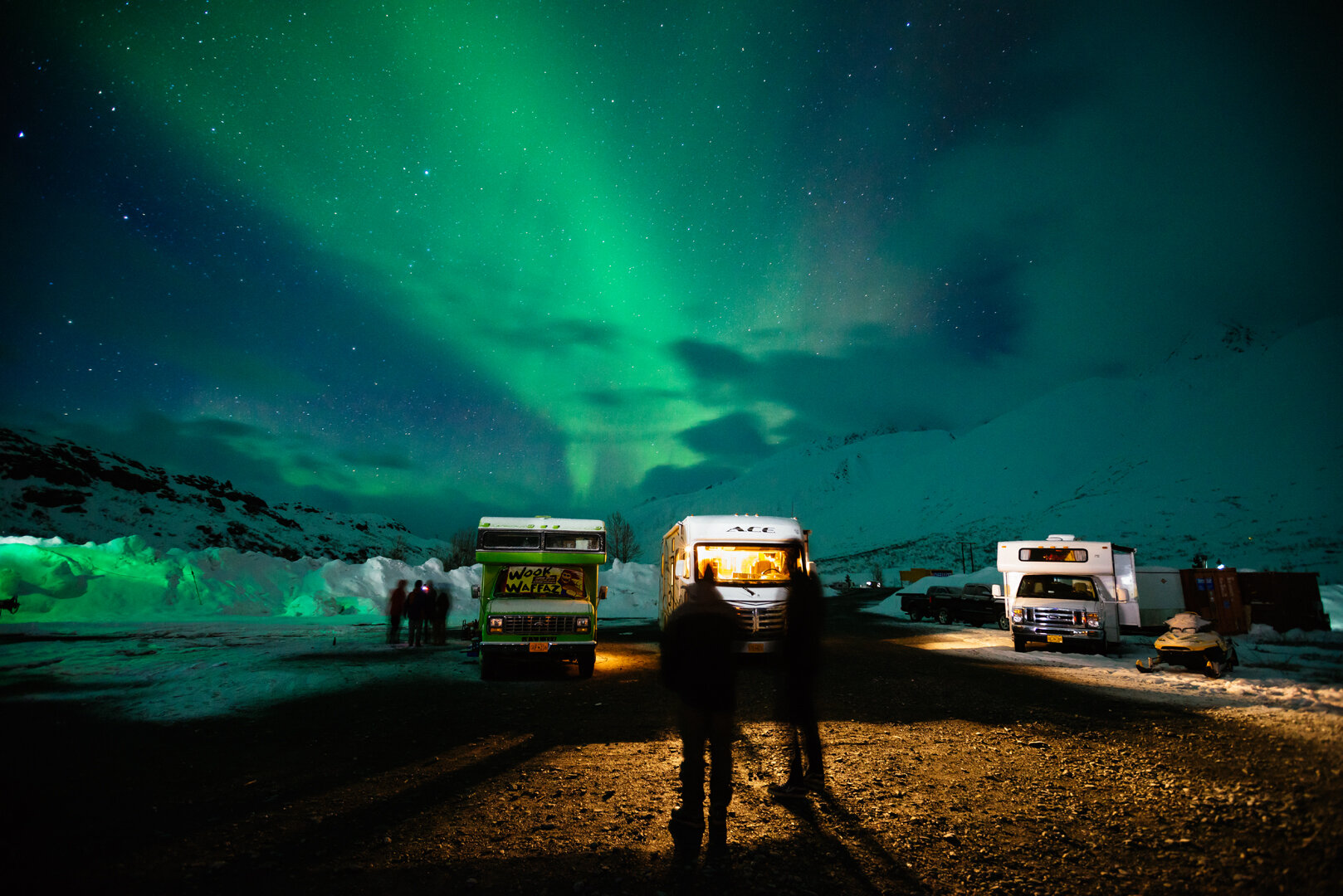
Our primary heli port doubles as a motor home base with wifi, cell service and a warm day lodge for drying gear. Most of the ASG staff stay up on Thompson Pass by choice — the sunsets, the northern lights, and the day lodge.
Magpies at our heli base runs week-long meal packages with breakfast, lunch and dinner, and daily meals as well. If you still have energy after a day in the helicopter, a few minutes on a sled gets you a lap of over 2,000 feet back down to the road. Spring light lasts to 9 or 10pm, and if you bring skins you can keep going up for a bigger line.
Gear
You probably already own what you need.
The gear you use here is no different from a normal backcountry day at home. It is easy to get excited and buy everything new, but Valdez is close to the ocean and rarely sees sub-zero temperatures — and the later in spring you come, the milder it gets.
On the hill
- Helmet
- Midweight base layer, top and bottom
- Pullover or zip-neck micro fleece
- Down or hybrid puff vest
- Compressible down or synthetic insulated jacket
- Waterproof shell and pants — think Gore-Tex
- Gloves, two pairs
- Goggles and sunglasses
- Wool or synthetic socks, at least three pairs
- Neck gaiter and/or light balaclava
- Ski hat
- Sunscreen and lip balm
Après, and life on the pass
- Jeans and casual clothes
- Snow boots
- Light hikers
- Down or synthetic jacket
- A heavier down or synthetic jacket
- Extra ski socks
- Ski hat
- Midweight gloves for hanging out and watching the northern lights
- Head lamp
- Boot dryer — the fire is not always enough
Demo gear
We keep the newest Lib Tech powder boards and skis, chosen for the Chugach. Let us know in advance if you want to demo so your setup is ready when you arrive.
Travel insurance
Buy it. There is no version of this where it is a bad idea.
Because of the overhead of running helicopters, we do not offer refunds for cancellations. Travel insurance reimburses that cost, plus expenses you incurred planning the trip, and it covers cancellation for illness, injury, death, flight cancellation, jury duty, or being laid off or called into work.
It also covers emergency evacuation. If something happens in the field there is no way to reach medical help except the helicopter, and that is very expensive — a flight to Anchorage, or worse a medically equipped aircraft to the lower 48, can easily exceed $50,000.
If you are visiting from another country, your health insurance at home may not cover injury or sickness on this trip. Travel insurance will. It also covers lost or delayed luggage and delayed flights — and note that if your arrival is delayed and you miss a fly day, we cannot refund it and your group's flight time still comes out of your package.
Our current recommendation is Global Rescue, which lets you pick the coverage you need.
Down days
Storm days happen. Plan for them.
When weather closes in we cannot fly. The FAA requires nearly all rotorcraft to operate under visual flight rules, and landing a helicopter on a ridge line with no visual reference is not something anyone should do. Because timberline sits so low here, there is very little terrain in Valdez with enough vegetation or rock to give you reference in flat light — vertigo is not fun, and an invisible terrain trap is worse.
Storms can last a few days, which is exactly why we ask you to come for at least a week. That gives the weather room to open a window.
On days we do not fly, we suggest resting — even getting a massage — so you are fresh when it breaks. We can also arrange ice climbing, skeet shooting or snowmobile riding.
Questions
The things people ask before they book.
Do I have to be an expert skier or rider?
No. You do not have to ride like a professional athlete to enjoy the big mountains and powder here. We do recommend arriving in fairly good physical condition and with confidence in your ability — but the range of terrain means you can ride anything from steep ramps to mellow grades with big powder fields. There genuinely is something for everyone.
Do I need previous backcountry experience?
No. Backcountry experience is a good foundation, but it is not a requirement. You get extensive safety briefings and training with our guides before your first run, and all the necessary equipment. Your guides also work with you in the field to assess snow safety and point out hazards.
What if I can't stay for a whole week?
If you can only come briefly, your timing with the weather becomes critical to whether you fly at all — which is why we do not offer packages shorter than seven days. We do offer daily heli rates on weeks with fewer than four groups; call in advance if you are planning to ride with us outside a package. Bear in mind our week-long packages cost less and include more riding than many operators' three- and five-day packages.
How does grouping and seating in the helicopter work?
The helicopter services up to four groups at a time. A group is a guide plus four or five clients, if the group's total weight allows the fifth seat. We aim to build groups well matched in ability and in the terrain they want to ride. It is unsafe for members of one group to take different runs off a drop unless there is more than one guide in that group, and even then it is the lead guide's call.
We do our best, but ASG reserves the right to fill seats at our discretion and cannot always guarantee you will ride with someone matching your ability. Because we know that affects your day, you have the option to buy one seat each day that would fly empty, at half the Classic package rate. ASG reserves the right to put a tail guide, apprentice guide or guide in that seat. The only guaranteed way to have your group exactly matched is to bring your own complete group or book a private charter.
What happens if someone in our group drops out?
Each person is responsible for completing the flight hours on their own package. If your group drops below four we will do our best to fill the seat with another guest or a tail guide. The person who is not there is still responsible for the hours the group uses that day. See our policies for the full explanation.
Can I come alone?
Absolutely. We will do our best to group you with riders of similar ability, and you will almost certainly leave with some lifelong friends.
How much should I tip my guide?
Gratuities are customary but entirely at your discretion. Tips generally range from $250 to $700 per guest on our packages. A percentage of your guide's tips goes to the ground crew and fuelers — none of this happens without them.
Have a question we did not answer? Get in touch — we are always happy to talk about this.